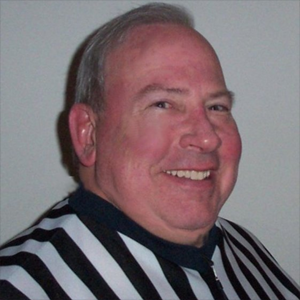
Rndballref
20 Years Experience
Chicago, IL
Male, 60
For twenty years I officiated high school, AAU and park district basketball games, retiring recently. For a few officiating is the focus of their occupation, while for most working as an umpire or basketball referee is an avocation. I started ref'ing to earn beer money during college, but it became a great way to stay connected to the best sports game in the universe. As a spinoff, I wrote a sports-thriller novel loosely based on my referee experiences titled, Advantage Disadvantage
You don't decide based on how you think it will affect the score, if you follow the Advantage Disadvantage philosophy you decide to ignore a violation or foul if the infraction did or did not cause an unearned advantage to the violator.
Share Answer: 

There is no distinction in the rule book about being on the ground except 1) a player who alights and shoots the ball is called an airborne shooter until he comes back to the ground, and if fouled even after releasing the ball the airborne shooter is in the act of shooting and 2) a player is considered to be in the act of shooting if he begins the habitual motion of shooting a try regardless of being on the floor or in the air.
Share Answer: 
No. There is no such violation. Likewise, there is no travelling on a throw in.
Share Answer: 
There is nothing worse than having an officiating partner with a chip on their shoulder, trying to be a tough guy, at any point in the game. Coaches need to respect an official, and usually that has to be earned over time. I think officials need thick skin always. Here's my red line: if a coach makes it personal in a derogatory way or if he questions my integrity then I would zap him right away, but I didn't call many technicals - I guess you would say I have thick skin. Guys who agitate coaches and call lots of Ts don't deserve to advance.
Share Answer: 
Personal Injury Lawyer
 How do I get out of jury duty?
Border Patrol Agent
 Do Mexican authorities help on THEIR side of the border?
Nurse Practitioner
 As gender roles continue to evolve, are you seeing a rise in the % of male nurses?
Yes, as long as you do not end your drivble, palm the ball or step into some else's space.
Share Answer: 
Normally, when you jump, you are considered to be in the court from which you jumped. BUT, there are three exceptions to this principle as far as back court violations are concerned: 1) on a jump ball, 2) on a throw in, and 3) when a defender jumps from his front court and intercepts the ball in the air and lands in his back court.
So to answer your question directly, no violation in either case if the ball is caught on the throw in.
Share Answer: 
To take a charge, a player must establish legal guarding position. That does not mean you have to stop. For example you could be defending while moving backwards, and you get run over - you established your right to the space, which is legal guarding position and it is a charge.
Share Answer: 
-OR-
 Login with Facebook
 (max 20 characters - letters, numbers, and underscores only. Note that your username is private, and you have the option to choose an alias when asking questions or hosting a Q&A.)
(A valid e-mail address is required. Your e-mail will not be shared with anyone.)
(min 5 characters)
By checking this box, you acknowledge that you have read and agree to Jobstr.com’s Terms and Privacy Policy.
-OR-
Register with Facebook(Don't worry: you'll be able to choose an alias when asking questions or hosting a Q&A.)



 Browse Jobs
 Host a Q&A
 Search

 Submit Your Question
 Host a Q&A
 Last 7

