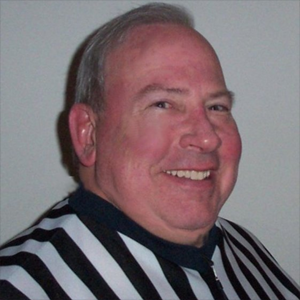
Rndballref
20 Years Experience
Chicago, IL
Male, 60
For twenty years I officiated high school, AAU and park district basketball games, retiring recently. For a few officiating is the focus of their occupation, while for most working as an umpire or basketball referee is an avocation. I started ref'ing to earn beer money during college, but it became a great way to stay connected to the best sports game in the universe. As a spinoff, I wrote a sports-thriller novel loosely based on my referee experiences titled, Advantage Disadvantage
Players should play until a whistle is blown. In your scenario the refs made two mistakes: 1) if there is not an advantage by the team in possession when the buzzer sounded, they should blow the whistle and find out what the timekeeper wanted, and 2) once they let the game continue then they should count all activities until the whistle.
Share Answer: 

A player must have at least one foot ON or Above a 3 foot wide (parallel to the out of bounds line) during the throw in. He/she may move forward or back all the way to the wall or bleachers perpendicular to the out of bounds line. There is no requirement to maintain a pivot foot on a throw in, nor can you travel. The violation occurs when the throw in player exits a 3 foot wide area along the boundary line before the throw in.
Share Answer: 
If the ball is live, then any foul can be called. If the ball is dead, the only foul which can be called is a technical.
On a throw in, the ball is live (even though the clock is not running) when it is at the disposal of throw in player ... in other words when the referee hands or bounces the ball to the player. So, yes a common foul can be called before the clock runs.
Share Answer: 
No. After returning to the floor the player is no longer in the act of shooting. It should be a non-shooting common foul.
Share Answer: 
Lifeguard
 Are most public pools just gross lakes of bodily fluids?
Security / Bodyguard
 Are you expected to take a bullet that's meant for someone you're guarding?
TV Meteorologist
 What were your worst on-screen bloopers?
If the officials determine that the fouls were simultaneous then no free throws are shot, and it goes back to the point of interruption. If the simultaneous fouls were committed with no team possession (for example while rebounding) then it goes to the possession arrow.
If the second foul was intentional and committed after the first foul it would be a technical. Then you would administer the penalties for the first foul (free throws if in the bonus or on a shooting foul), then you would administer the technical foul and the ball would be taken out at half court by the opponent of the technical foul shooter.
Share Answer: 
This is a tough question. There was a Wall Street Journal article which addressed the grey areas of what an assist is. Here is a quote from that article:
"The NBA statistician's manual says an assist should be "credited to a player tossing the last pass leading directly to a field goal, only if the player scoring the goal responds by demonstrating immediate reaction to the basket." It sounds simple enough. As assist is a pass made to a shooter who scores. But when you try to apply this definition during a game, it gets murky. There are no details about how many steps shooters can take after receiving a pass; nothing about shot-fakes, head-fakes or pivot moves and no hard guidelines on how much time can elapse between the pass and the shot.
Share Answer: 
Ok. Situation 1: Offensive player A1 drives, shoots the ball while in the air and is fouled by defensive player B1 (before A1 returns to the floor). A1 is considered an "airborne shooter" until he hits the ground and is considered in the act of shooting. Count the basket and award one free throw.
Situation 2: Offensive player A1 drives, shoots the ball and lands back on the floor and is fouled by B1. Possession ended when the shot is released and the shooter is no longer an airborne shooter in the act when he lands on the floor. So when he is on the floor it is a common foul on B1 and award the ball to team A or free throws if in bonus. Count the basket by A1.
Situation 3: Offensive player A1 shoots the ball, ball goes in, and A1 crashes illegally (before landing on the floor) into B1 who has obtained legal guarding position, player control foul on A1. Ball goes to team B and no free throws. Wipe out made basket by A1.
Situation 4: Offensive player A1 shoots the ball, lands on the floor, ball goes in and A1 fouls B1. Count the basket. Common foul on A1, free throws for B1 if in bonus, otherwise ball goes to team B.
Share Answer: 
-OR-
 Login with Facebook
 (max 20 characters - letters, numbers, and underscores only. Note that your username is private, and you have the option to choose an alias when asking questions or hosting a Q&A.)
(A valid e-mail address is required. Your e-mail will not be shared with anyone.)
(min 5 characters)
By checking this box, you acknowledge that you have read and agree to Jobstr.com’s Terms and Privacy Policy.
-OR-
Register with Facebook(Don't worry: you'll be able to choose an alias when asking questions or hosting a Q&A.)



 Browse Jobs
 Host a Q&A
 Search

 Submit Your Question
 Host a Q&A
 Last 7

