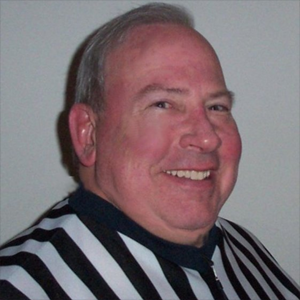
Rndballref
20 Years Experience
Chicago, IL
Male, 60
For twenty years I officiated high school, AAU and park district basketball games, retiring recently. For a few officiating is the focus of their occupation, while for most working as an umpire or basketball referee is an avocation. I started ref'ing to earn beer money during college, but it became a great way to stay connected to the best sports game in the universe. As a spinoff, I wrote a sports-thriller novel loosely based on my referee experiences titled, Advantage Disadvantage
If the ref calls for the ball you should give it up. If you defy the ref it could be construed as disrespectful by a thin-skinned official. So yes, it could be called. BUT I never have made that call and I advise refs not to.
Share Answer: 

It depends on 1) your current size and potential size and 2) your level of fundamental skills (dribbling, shot accuracy, speed, passing, basketball IQ, selflessness, and most importantly the needs of your team).
Share Answer: 
The rulebook provisions of the 3 second rule is that a player cannot be in the lane for 3 seconds or more while his teamates have established team possession in their frontcourt.
If a player has either foot on the edge or line which defines yhe lane, he is in the lane.
There is an interesting exception to a 3 count. A player can legally be in the lane for as much as 6 seconds as follows: he is in the lane for a count if 2 and receives the ball, the holds the ball for 2 counts and dribbles - he gets another 2 count. Then he must shoot .
But to your point, most experienced officials rarely call 3 seconds. You see newer referees at freshman games call it way too often. Most officials are taught that 3 seconds should only be called if and only if it results in an undue advantage. Thr principal is called Advantage Disadvantage. This means that when it is called it is ususlly a late call.. for example a player is camped out and normally when the shot goes up the 3 seconds restrictions are lifted, but if that player gets the rebound because he was there for more than 3 seconds the official should call it then.
A good preventative officiating move is for the official to shoo players out of the paint verbally to avoid having to call 3 secs too often.
Share Answer: 
I understand your point. In nearly all sports, coaches make moves that help determine the outcome of games; time outs, call in plays etc. I think the NFHS needs to decide if they want to completely eliminate the "everyone in the gym knows it is an intentional foul" being ignored or called as a common, or leave it unevenly called as it is. In the past they have tried to issue guidelines, but the gray area for interpretation is a mile wide. Don't know how much noise they hear about this issue, but NFHS has not settled on a good solution yet.
Share Answer: 
Waitress
 Do you get annoyed when people use Groupons?
Special Education Teacher
 Does it bother you when people use the R-word?
Auto Mechanic
 Are mechanics more likely to take advantage of female customers than males?
In theory, swatting a defender's arms is a violation. If a defender has the right to a space, swatting his arms is a foul. But if the defender is handchecking (or forearm checking) an experienced ref would either call a foul on the defender, or not call anything. Instead he could warn both players to keep their arms off each other. Unfortunately, often the offensive player gets caught swatting because the ref missed the initial armcheck.
Share Answer: 
I don't think there is a perscribed rotation as to which referee should put the ball in play. As a practice, after one of my partners called a technical foul I would have him be the official to put the ball in play, thereby putting him opposite of the table and benches.
I think your question is after a technical, is the throw in official the new trail? And the answer is yes. On any sideline throw in, the lead should come to the trail half of the court, making the throw in official the trail.
Share Answer: 
Sounds like a bad call. The center for Team A does not establish team possession by tipping the ball, but by knocking the ball out Team B gets the ball. Because neither team had possession and B got the first ball the arrow is set for Team A's possession on the next one.
Share Answer: 
-OR-
 Login with Facebook
 (max 20 characters - letters, numbers, and underscores only. Note that your username is private, and you have the option to choose an alias when asking questions or hosting a Q&A.)
(A valid e-mail address is required. Your e-mail will not be shared with anyone.)
(min 5 characters)
By checking this box, you acknowledge that you have read and agree to Jobstr.com’s Terms and Privacy Policy.
-OR-
Register with Facebook(Don't worry: you'll be able to choose an alias when asking questions or hosting a Q&A.)



 Browse Jobs
 Host a Q&A
 Search

 Submit Your Question
 Host a Q&A
 Last 7

