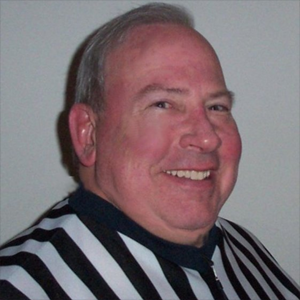
Rndballref
20 Years Experience
Chicago, IL
Male, 60
For twenty years I officiated high school, AAU and park district basketball games, retiring recently. For a few officiating is the focus of their occupation, while for most working as an umpire or basketball referee is an avocation. I started ref'ing to earn beer money during college, but it became a great way to stay connected to the best sports game in the universe. As a spinoff, I wrote a sports-thriller novel loosely based on my referee experiences titled, Advantage Disadvantage
Carrying the ball is one of ways the rule book states that a dribble comes to an end. So the very next dribble should be called as a double dribble if the player carried the ball prior to the subsequent dribble. My opinion is that refs have allowed too much carrying to go on - the dribbler gains too much control of the basketball if you let a player cup or turn over the ball.
Share Answer: 

OK, we need some common sense here. Normally after a time out and the warning horn sounds, a player would be denied entering the game. This is to eliminate delays due to substitution gamesmanship (in pro hockey for example the home team has "last substitute"). But in the case where a coach has 30 seconds to replace a fouled out player this rule should not, and does not apply to either team. If common sense prevails, the officials should let A-6 in the game.
Share Answer: 
Fifteen minutes before the game, the officials are to take their positions on the court. An Umpire (U1 & U2) stand on the sideline at approximately the free throw line extended. While walking to their positions, all officials are to look for obstructions, short throw in areas, proper bench locations, and proper coaches boxes. The referee stands at half court. The umpires are tasked with 2 things: get a count of the players and look for faulty or illegal equipment (metal clips in hair, unauthorized uniform variances, etc.). The referee takes the player count from both umpires and between 10-12 minutes before gametime the referee checks the scorer's book to 1) ensure that the book has at least as many entries as there are players warming up, and 2) that the starters are designated in the bokk no later than 10 minutes before game time. Once the book is verified, the referee calls the umpires together along with team captains and coaches. The referee normally conducts the pregame with mandatory state-required admonishments. Then the referees go back to their positions and right before the nationa anthem stand in front of the scorers table.
I never found a coach trying to take advantage of equipment except there have been over or underinflated balls that I have adjusted. Many referees carry an inflation pin in case they have to let some air out of a game ball.
Share Answer: 
In NFHS all flagrant fouls (personal or technical) result in 2 free throws plus the ball at half court. In addition, the player charged with a flagrant foul is immediately disqualified. You never shoot 1 and 1 on a flgrant foul.
Share Answer: 
Couples Therapist
 Does a therapist aim to "fix" the client, or just treat the client indefinitely?
Hairstylist and Makeup Artist
 What's the grossest hair ailment you ever saw?
Certified Nurse Aide
 Is it uncomfortable having to help the elderly go to the bathroom and how did you get used to it?
Rule 6 Section 3 Article 3... Teammates shall not occupy adjacent positions around the center restraining circle if an opponent indicates a desire for one of these positions before the referee is ready to toss the ball.
Share Answer: 
There is no provision for a referee to overrule another official in the Federation rules book, however in practice one official is designated as the referee in a crew with a responsibility to resolve simultaneous calls. My experience is that before the game this situation is discussed between officials. I think it is important to get the call correct, but each referee has his own area to watch. So if I make a call that one of my partners sees a different way I want that official to approach me, tell me what they saw, I give my perspective and then I decided if I will overrule my own decision. That way I can defend the final outcome. So, a few principles: 1) a ref should be watching their own area - that is why you have 2 or 3 of them, 2) there is some overlap and sometimes a second look sees something you can miss, and 3) officials should decide how they will consider overruling each other before the game. Based on your description (that the shot was clearly made from inside the 3 point line), regardless of how the ref's changed the call they apparently got it wrong.
Share Answer: 
Well, the referee is considered to be part of the floor where he is standing. If he is out of bounds and the ball touches him, it is out of bounds. If he is in bounds and the ball touches him, play on.
Share Answer: 
-OR-
 Login with Facebook
 (max 20 characters - letters, numbers, and underscores only. Note that your username is private, and you have the option to choose an alias when asking questions or hosting a Q&A.)
(A valid e-mail address is required. Your e-mail will not be shared with anyone.)
(min 5 characters)
By checking this box, you acknowledge that you have read and agree to Jobstr.com’s Terms and Privacy Policy.
-OR-
Register with Facebook(Don't worry: you'll be able to choose an alias when asking questions or hosting a Q&A.)



 Browse Jobs
 Host a Q&A
 Search

 Submit Your Question
 Host a Q&A
 Last 7

